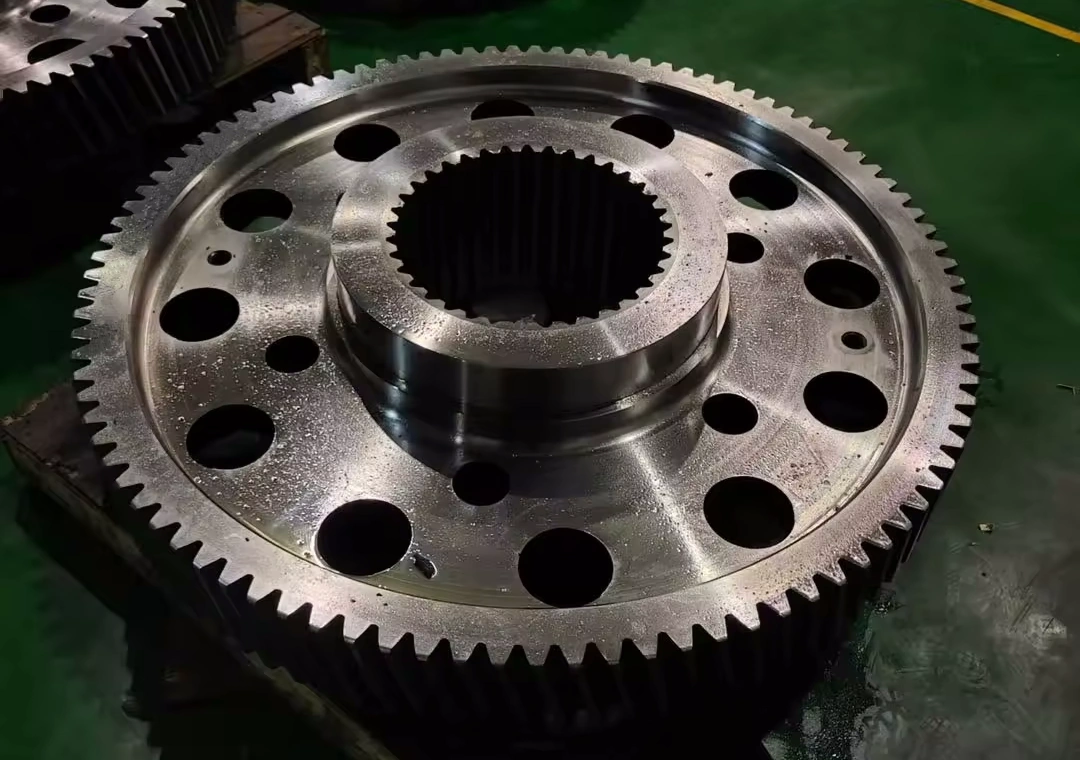
Gear types we manufacture
We produce custom gears to drawing for power transmission, motion control and OEM assemblies - from single prototypes to production series. Our range covers:
- Spur gears - the most common type, for parallel shafts and straightforward power transmission.
- Helical gears - quieter and stronger than spur gears, for higher loads and speeds.
- Bevel and crown gears - for transmitting motion between intersecting shafts.
- Worm gears and worm shafts - for high reduction ratios in a compact envelope.
- Internal (ring) gears - for planetary systems and compact drives.
- Gear racks, splined shafts and sprockets - for linear motion and chain drives.
Gear manufacturing processes
The right process depends on size, accuracy class and volume. We use gear hobbing for external spur and helical gears, gear shaping for internal gears and tight-shoulder geometries, and 5-axis CNC milling for bevel gears and one-off prototypes. For the highest accuracy, teeth are finished by profile grinding. For high-volume small gears, sintered powder-metal gears offer a near-net-shape, low-waste alternative.
Materials and heat treatment
Gear performance is set as much by material and heat treatment as by geometry. Common choices:
- Case-hardening steels (16MnCr5, 18CrNiMo7-6) - a hard, wear-resistant surface over a tough core.
- Through-hardening steel (42CrMo4) - for highly loaded gears and shafts.
- Stainless steel - for corrosion resistance and hygienic applications.
- Brass and bronze - for worm wheels and low-noise, low-load gears.
- Engineering plastics (POM, PA) - for quiet, lightweight, lubrication-free drives.
Typical treatments include case hardening, induction hardening, nitriding and quench-and-temper, followed by grinding where final accuracy demands it.
Gear accuracy and quality control
Gear accuracy is defined by quality classes to DIN 3962 / ISO 1328 (lower number = higher accuracy). The class you need drives both process and cost:
| Process | Typical accuracy | Application |
|---|---|---|
| Profile grinding | DIN 4-6 | High-speed, low-noise, high-load drives |
| Hobbing / shaping | DIN 7-8 | General industrial gearboxes and drives |
| CNC milling | DIN 9-10 | Prototypes, large or low-speed gears |
| PM sintering | DIN 9-11 | High-volume small gears |
Every gear is inspected on gear-measuring and CMM equipment - profile, lead, pitch and runout - and supplied with a dimensional report on request.
How to order custom gears
To quote quickly and accurately, send a drawing or simply these parameters:
- Module (or DP), number of teeth and pressure angle
- Helix angle and hand (for helical gears)
- Face width, bore and keyway or spline
- Quality class, material and heat treatment
- Quantity and any reference sample or existing gear
No drawing? Send us a sample or a worn gear. We can reverse-engineer the geometry and reproduce it to the original specification.
Why source gears from BIB Parts
We are a single-source manufacturing partner: gear cutting, heat treatment, grinding and surface finishing backed by in-house engineering and a DFM review on every quote. From a single replacement gear to a production series, you get one supplier, one point of contact and consistent quality. See all our manufacturing capabilities or request a gear quote.